dimarts, 28 de maig del 2013

Trenches


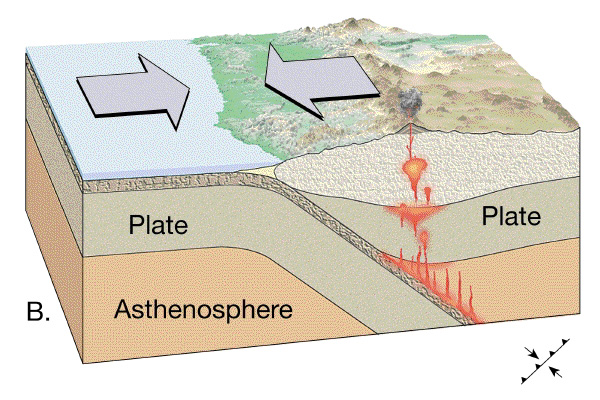
When the subducting plate is bent downward to form a very deep depression in the ocean floor, this is called an Oceanic Trench.


The age of the ocean floor increases as the distance from the ridges increases. The oldest seafloor often ends in the deep-sea trenches.  Like the mid-oceanic ridges, the trenches are seismically active, but unlike the ridges they have low levels of heat flow. 

The Evolution of The World

At the begining, when the Earth was created, all the continents where one. Actual scientists called the continent Pangea. Slowly they started moving away of each other with the tectonic plates process.They slowly moved away until they formed our actual continents. The continents are still moveing.
           Pangea


           The world 250 years from now

Continental Rifting


Rifting is the process by which the continental lithosphere stretches, at a divergent boundary plate. A Continental rift is the belt or zone of the continental lithosphere where the extensional deformation (rifting) is occurring.  These zones are very active geologically (volcanoes, earthquakes), and if the rifting is successful, lead to the formation of new ocean basins. 


.

Subduction


Oceanic lithosphere subducts underneath the continental lithosphere. Oceanic lithosphere heats and dehydrates as it subsides. The melt rises forming volcanism 

E.g. The Andes

Wilson Cycle With Video


The wilson cycle is a process by which the crust moves divergently. The crust separes and water comes in creating a new ocean. Then the crust moves convergently and gets together again, the ocean disapears.


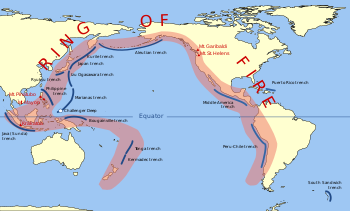
The Ring of Fire

The Ring of Fire is an area where a large number of earthquakes and volcanic eruptions occur in the basin of the Pacific Ocean.
In a 40,000 km horseshoe shape, it is associated with a nearly continuous series of oceanic trenches, volcanic arcs, and volcanic belts and/or plate movements.  
The Ring of Fire has 452 volcanoes and is home to over 75% of the world's active and dormant volcanoes.

dijous, 23 de maig del 2013

Types of Movements

THERE ARE THREE TYPES OF PLATE BOUNDARY:

- Convergent:

    · There are three styles of convergent plate boundaries
             –Continent-continent collision
             –Continent-oceanic crust collision
             –Ocean-ocean collision


- Divergent   
It’s where two tectonic plates are moving away from one another. Two main geological features: Mid-                     Oceanic Ridges and Continental Rifting.


- Transform 

As two plates slide past one another, in a transform boundary, neither plate is added to at the boundary, nor destroyed. Often found near the mid-oceanic ridges.


Video: Types of movement


 → ←                            
 ←                                      ↑ 


dimecres, 22 de maig del 2013

Plate Tectonics Introduction

Lets start with an introduction of Plate Tectonics:

  • Plate Tectonics is the study of how it is that continents are able to move around the word's crust.
What are tectonic plates?


  • There are seven large plates and several smaller ones, all moving very slowly at diferent speeds and directions.
  • Some of them are under the oceans, those are called oceanic plates and some of them are under continents, they are called continental plates.
  • A boundary is where two plates meet, this is the place where new crust forms and the old crust is returned to the core to be melted again.
  • The proces of new crust forming takes about 100 million years.
  • Tectonic plates are made of rigid lithosphere.

We should already know that the Earth is formed of 4 main layers: the inner core, the outer core, the mantle and the crust.
  • The core is made mostly of iron. 
  • The inner core is under such an extreme pressure that it remains solid,
  •  the outer core is liquid. 
  • The liquid in the outer core flow in currents that makes the magnetic field of the Earth.


What is the lithosphere?
  • The lithosphere is made of the crust and the upper mantle, it flotes on top of the asthenosphere, which is also part of the upper mantle and goes down to a maximum depth of 600km.